
Purpose, Big Problems, and Sacrifice
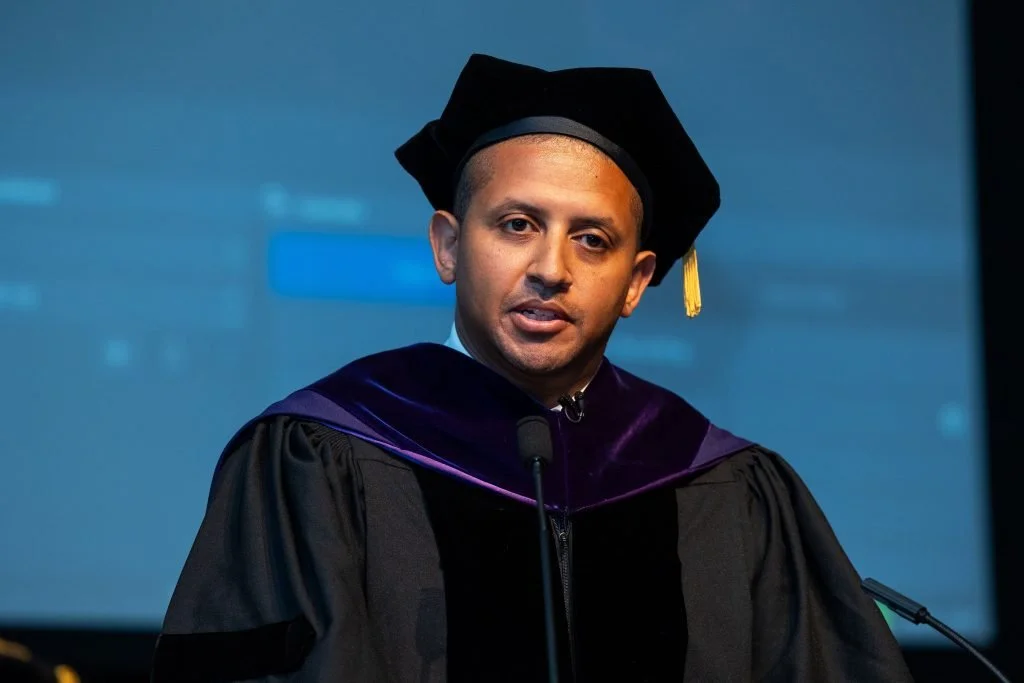
Delivering the Distinguished Alumnus Address at the University of Washington Commencement, 2023.
When the political science department first reached out to me about receiving this distinction and delivering this address today, my initial reaction was one of gratitude. It was incredibly humbling to be invited back to the University of Washington — a place I love so much, that is so core to the person I have become — for such a special recognition.
My second reaction was one of surprise. Aren’t I too young for this? And to be giving this speech? When did I graduate?
As it turns out, I’m much older than I thought I was. I graduated from the UW 15 years ago now, and arrived here on campus as a freshman 20 years ago.
I suppose my first words of wisdom for you today are that time flies. Time really does fly.
“Time flies. Time really does fly.”
Preparing for this speech was a really interesting experience for me. I spent the past several weeks reflecting on my experience at UW, who I was then, and who I have since become. I kept asking myself, what did I really need to hear when I sat where you sit? What was the voice and the words that I really needed to hear then?
What I realized — and what I kept coming back to — were three things: purpose, big problems, and sacrifice. Real, meaningful sacrifice. More on all of those three things in a minute.
When I graduated from the University of Washington, in many ways I was very lucky. I left UW priding myself on being this person who had a really confident, clear sense of self. I really thought I knew who I was — and to some extent I did.
I had poured myself fully into the founding of the Dream Project, a program on campus dedicated to creating opportunity for low-income and first-generation students like myself to pursue higher education. A program that I’m so proud of — it’s still thriving, serving thousands of students in King and Pierce and Snohomish Counties.
The Dream Project gave me my sense of purpose. It anchored my time here at UW.
When I graduated, it was really hard for me to leave the Dream Project. But I knew it was the right time for the program to have a new executive director, and I knew personally I had to move on. So much of my identity, my sense of self, my purpose was wrapped up in this all-consuming work. Yet when I sat where you sit today, I found myself dragging my heels about the future.
Why? What exactly was holding me back in this transition after college?
It was then, as I thought about what came next, that I had my first important reflection: purpose in and of itself is not enough.
“Purpose in and of itself is not enough. Purpose needs to be anchored to a problem — to a problem to solve.”
We all talk about finding your purpose, but what I’ve learned is that purpose needs to be anchored to a problem — to a problem to solve.
What do I mean by that? At UW, I was passionate about social justice. But I was also lucky enough, through the Dream Project, to find and be consumed by a big problem to solve. That is what fueled me. And I now felt like I desperately needed a big problem to solve.
In those years after UW, I was lucky enough to have some amazing opportunities and experiences, including working in the Obama Administration.
During that time, I came across the problem that would grip my mind and ultimately shape the next chapter of my professional and academic experience — although at that time I didn’t know it.
While at the U.S. Department of Education, I was a part of a team leading the effort to try to structure an R&D infrastructure for the education sector. Our flagship effort was to establish an advanced research agency for education — one modeled after DARPA, the Defense Advanced Research Projects Agency.
From this work, I was consumed by thinking about this broader question: Where do breakthrough innovations come from to solve the most significant problems that face disadvantaged communities, that face our cities, our state, our country, and even the world? What was this replicable process? What is the institutional vehicle that would allow us to solve these problems at scale? How would we bring the smartest and the brightest to consider these questions?
Here I found a big set of problems that I believed were consequential, that felt worthy of my intellectual energy.
But there was still something pulling at me — this weight, this burden, this feeling I couldn’t shake, couldn’t put words to yet.
It all came to a head when I was in law school. I came up to Yale still thinking deeply about these questions from my time in D.C. At the same time, throughout my law school experience, I watched my friends — even many who cared deeply about public service — channeling their sense of purpose into the pursuit of competitive, high-prestige opportunities: judicial clerkships, corporate jobs, positions at big high-paying New York City law firms.
But I just couldn’t do it. And I don’t mean that in a righteous way — I mean I literally could not do it. It didn’t even feel like a choice.
My whole adult life, my identity was defined by this self-narrative I told myself: this against-all-odds success story of a first-generation immigrant who had overcome incredible hardship throughout my childhood to set off on an improbable path to where I am today.
I thought about my younger self. I thought about all of us: my mom and six kids living in a two-bedroom apartment in Federal Way; my parents going six years without seeing my dad; my older brother, who took me in when I was twelve and my mom had to go back to Ethiopia, who worked as a luggage handler at Alaska Airlines, taking every shift he could, sleeping on the break-room couch so he could save up the money to take care of me and send the rest back to Ethiopia to support my parents.
I thought about my other older brother, who in his early thirties, with a wife and a baby, was then saddled with having to take care of my younger brother and me through high school.
I even thought about a family in Seattle we got to know years before, who, out of pure benevolence, offered to sponsor my sisters to come to the U.S. — very literally changing the trajectory of my family’s life.
I thought about all of these countless acts — the sacrifice of my parents, my siblings, neighbors, teachers, mentors. I thought to myself, if what all of this tremendous struggle amounted to was that I was wealthy, that I had a prestigious job, I knew selfishly that I wouldn’t be able to live with myself. I had to live up to the sacrifice, honor the struggle, and make sense of how capricious fortune had favored me.
I had to show to myself that I was willing and unafraid to take risks. Anything short of that felt like a betrayal of all those who had believed in me when I was young, of those who had given me opportunity along the way — and most of all, to myself.
Finally I had the clarity I was searching for. I was finally able to name that thing that had been weighing on me for all these years: it was this idea of sacrifice.
This was my second important reflection. Yes, purpose needs to be anchored to a problem to solve. But there’s something more: solving a big problem of consequence requires sacrifice.
“When your success is built on the sacrifice of others, you hold a burden, you shoulder an obligation.”
I had to prove to myself that I was willing to sacrifice, like those who had sacrificed for me. When your success is built on the sacrifice of others, you hold a burden, you shoulder an obligation.
By the end of law school, I had finally crystallized a vision for an organization that would serve as an answer to the questions I had now — at this point — been struggling with for years: How could we create the R&D infrastructure to solve big problems facing low-income communities in different sectors — education, health, housing, environmental justice?
The organization was called Bonds of Union. At its core, the vision was simple: we would build cross-sector teams to come together for three to five years around narrow, well-defined problems and generate breakthrough innovations that would address the most important challenges facing our country.
What Bonds of Union offered was a unique approach to problem-solving. We would start with a problem, generate a potential solution, test it and implement it in the field, and refine and validate the model.
We viewed higher education institutions — like this one, like the University of Washington — as the best institutional vehicle for realizing this effort at scale, where teaching and learning, research, would be oriented around the practical act of solving complex problems, providing students and faculty and staff an opportunity to engage in cross-sector, interdisciplinary research and problem-solving that would generate new knowledge and solve the most consequential challenges facing our country.
Our vision was to reorient an institution of higher education to make it the center of your learning experience, solving a big and complex problem, anchoring your sense of purpose, and shaping your source of meaning.
To realize this vision that I believed in so deeply was going to require sacrifice as meaningful as the idea itself. I would need to launch a pilot, build a team, and validate the model.
Let’s fast forward. I’ve moved to Cincinnati to carry out our first pilot project, an education-focused initiative aimed at improving academic and social-emotional outcomes for the lowest-performing students in high-need elementary schools.
Work was hard from the very start. We struggled to generate the resources, funding, support for myself and our small team. Implementing the solution in our first pilot school proved to be difficult. And not to mention there was the added burden of making the sacrifice worth it for this exceptional subset of individuals that I had compelled to uproot their lives and join me in carrying out this vision.
I was living out a long-held dream exactly as I’d hoped — being meaningfully embedded in the community, testing a real solution, doing work that I believed was consequential.
I had stepped off the more predictable, prestigious career path by choice, but here I was now, for the first time, really feeling the weight of my decision — and not just for myself. Everything was hard. Everything. And at times, overwhelming.
Which brings me to my third and final important reflection: real sacrifice isn’t easy, but it’s critical to realizing any work of meaningful value.
“Real sacrifice isn’t easy, but it’s critical to realizing any work of meaningful value.”
For me, sacrifice meant many things. First, it meant stepping away from the traditional, safe, more lucrative career path. Second, it meant potentially disappointing family or others who for so many years had been invested in my success. Even though this was the best way I knew how to honor the sacrifices they made for me, they would be the first to tell you that my decision to pursue this career path wasn’t easy on them either.
And lastly — perhaps more significantly, on account of these two things — sacrifice meant that I was forced to have really difficult conversations with myself to confront uncomfortable truths about my own sense of identity.
Those first years in Cincinnati, it was this really interesting moment for me personally. I’m in the Midwest, where I have no professional relationships, no mentors, no one who knew I founded the Dream Project or worked in the Obama Administration or had gone to Yale Law School. No one who knew the struggle it took, the hardships I endured, to get to this point in my journey.
So who was I now? Who was I without this constructed identity, this narrative of success? Who was I?
The first thing I had to do was remind myself: at the end of the day, when everything is stripped away — your accomplishments, your ambitions, your challenges, your sense of self that you’ve developed based on how others view you, what they expect of you — what’s left is who you are.
You are not your degree. You are not your GPA — good or bad. You’re not that feeling of trying to make your parents or family proud. You are what you value.
“You are not your degree. You are not your GPA — good or bad. You are what you value.”
I think a lot about my daughters — my five-year-old Jory, who’s here today, my two-year-old Remy, and my soon-to-be-born twin daughters. Any day now.
They are the love of my life, the anchors of all of my hopes and dreams.
What serves as my North Star, my motivation at this point in my life, is to try to live a life worthy of being lucky enough to be their father.
Years from now, over time, they won’t be proud of me for my accomplishments or for titles I held or the amount of wealth I was able to accrue. They won’t even be proud of me for the good I did, but for how good I was.
Ultimately, that’s what matters — the person I was, and am, and continue to try to become. All of this is what amounts to having a purposeful, balanced, fulfilling life.
You see, when I sat where you sit, what I needed was not career advice. What I needed was life advice.
So what are the big takeaways here for you today?
Find your big problem to solve. And when you do — when you find it — commit yourself with abandon. Give it both your mind and your heart.
After you’ve found it, make sure you get on the ground, get your hands dirty, and embed yourself in the community. Because ultimately that’s how you really, truly understand the problem.
Want to go into state or federal policy? Go on — but try to deeply understand the experiences of those you’re trying to serve, not just from policy briefs and news articles, but meaningful human interactions. See it for yourself.
Do it early, and do it now. This is when you should take risks. Those jobs — the ones with higher-paying salaries or prestige — will still be there, I promise you. You’ll be much better equipped to take them on — or traditional policy jobs, or finance positions, med school, whatever path you’re on — with the clarity and sense of purpose you’ll gain from these experiences.
Some of you may feel some obligation already to do something big, something that matters, that requires sacrifice — maybe because of your own improbable journey like mine to the seat you’re in today.
For others of you, and perhaps even more powerfully, you have an opportunity to do this out of pure choice — out of principle. You’re going to decide to dedicate yourself to a life of unwavering purpose. Whatever your reason that gets you there, whatever compels you, I hope you take that opportunity.
“Find your big problem to solve. And when you do — when you find it — commit yourself with abandon. Give it both your mind and your heart.”
There’s no doubt that at times what you’re doing will feel hard. You may wonder if the sacrifice was worth it. But one day you too will realize — whoa, I’m older than I thought I was — and you will reflect on the person that you were and the person that you’ve since become.
Have confidence that you’ll come out with a stronger, clearer sense of who you are, who you really are, and what you value, what you’re about. The satisfaction, you will learn, isn’t in the doing or the outcomes. It’s in the being.
That’s what it does to you as a person. You’ll be more ready than you could have ever imagined to go out into the world and do big, consequential things and live a life that is fulfilling and full of meaning.
So find your purpose, your big questions, and how you will sacrifice to do great things. Go out and do it now.
Because remember — time flies.
